
Genesis 11:10-26
Ancient Formations
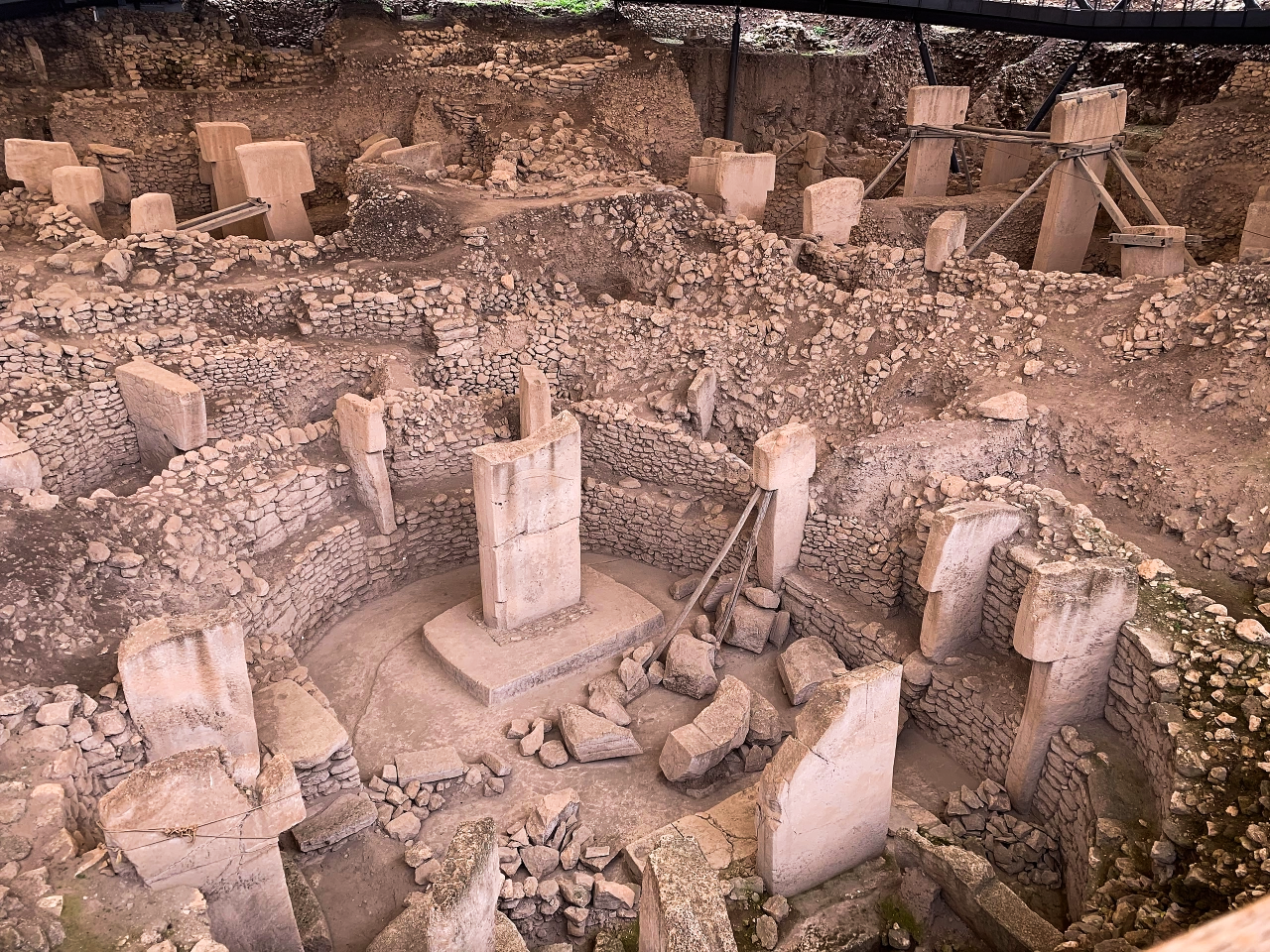
Image Caption: Göbekli Tepe, the oldest monolithic circle complex. Source: Göbekli Tepe (Facts and Details) [https://factsanddetails.com/world/cat56/sub362/entry-6007.html]
Gobekli Tepe is located in southeastern Turkey, 10 kilometers from Urfa (a possible location of the 'Ur' of Terah). Gobekli Tepe is the world’s oldest sacred monolithic complex (9500 to 8000 BC) — 6,000 years older than Stonehenge and 5,000 years older than the Egyptian pyramids. Its circular precincts rest on a hilltop that holds many megaliths carved with images. Because of similar alignments among its monolithic circles, it is likely it was an ancient observatory. It was built during the hunter-gatherer age millennia before metal tools or pottery appear in archaeology.
Postdiluvian Vertical Genealogy Abram's Way of Redemption
It was during the last days of the culture of Ur III (in ancient Sumer) that Terah's family would emerge to relate their story of relocating from Ur to Haran. Even before the rise of the Old Babylonian kingdoms of Isin and Larsa (2017 to 1794 BC), Terah's family would settle in Padan-Aram (now Syria), from which Abram would travel to the Canaanite Levant. Some argue that Terah's family traveled from Ur in southern Mesopotamia to Haran; others that they traveled from Urfa in southeastern Anatolia to Haran. Either way, the cultural influence of Neo-Sumerian Ur III would have reached the entire region from southern to northern Mesopotamia to one degree or another.
Mesopotamia had entered the era when law codes extended the influence of city-states over vast regions. In time the social impact of such law codes would reach into surrounding cultures, including those of the Levant. The oldest known law code, that of the Sumerian Code of Ur-Nammu (ca. 2100 to 2050 BC), would be followed by the Sumerian Code of Lipit-Ishtar, ruler of the First Dynasty of Isin (ca. 1934 to 1924 BC), then by the Old Babylonian Code of Eshnunna (ca. 1930 BC) and Code of Hammurabi (ca. 1792 to 1750 BC).
Israel as a nation was yet unknown. It would be generations before Joseph's family would rise to power in 12th Dynasty Egypt (1991 to 1782 BC) and his heirs continue rule into the Second Intermediate Period (1782 to 1550 BC) — especially in the 14th and 15th Hyksos Dynasties at Avaris. For the verses of Genesis under consideration, the stage for God's plan of world redemption was being set.
Postdiluvian Vertical Genealogy Genesis 11:10-26
By now, it should be evident that the genealogies of Genesis 1–11 trace a vertical line of decendency from Adam to Abram. Because the line of descendency and the chronology it supplies appear to form an unbroken collinear sequence, some scholars deduce that the biblical patriarchal record forms a closed chronology (without gaps) from the first human being to Abram.
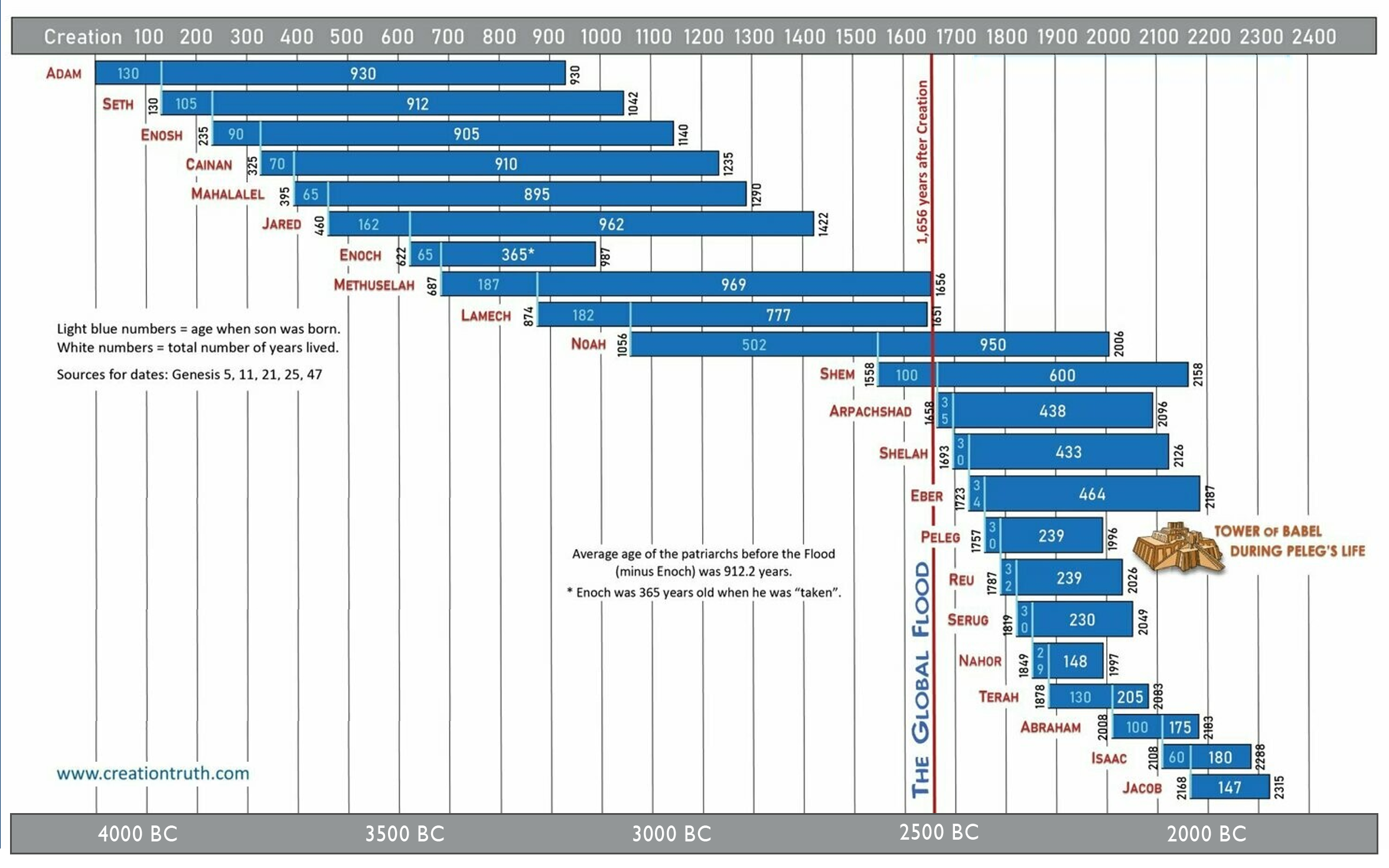
Image Caption: Biblical Chronology of Pre- and Post-Diluvian Patriarchs. Source: Ages of the Patriarchs (Creation Truth Foundation) [https://www.creationtruth.com/] and [https://s3.amazonaws.com/images.ecwid.com/images/51635246/2235032172.jpg]
tôledôṯ of Shem
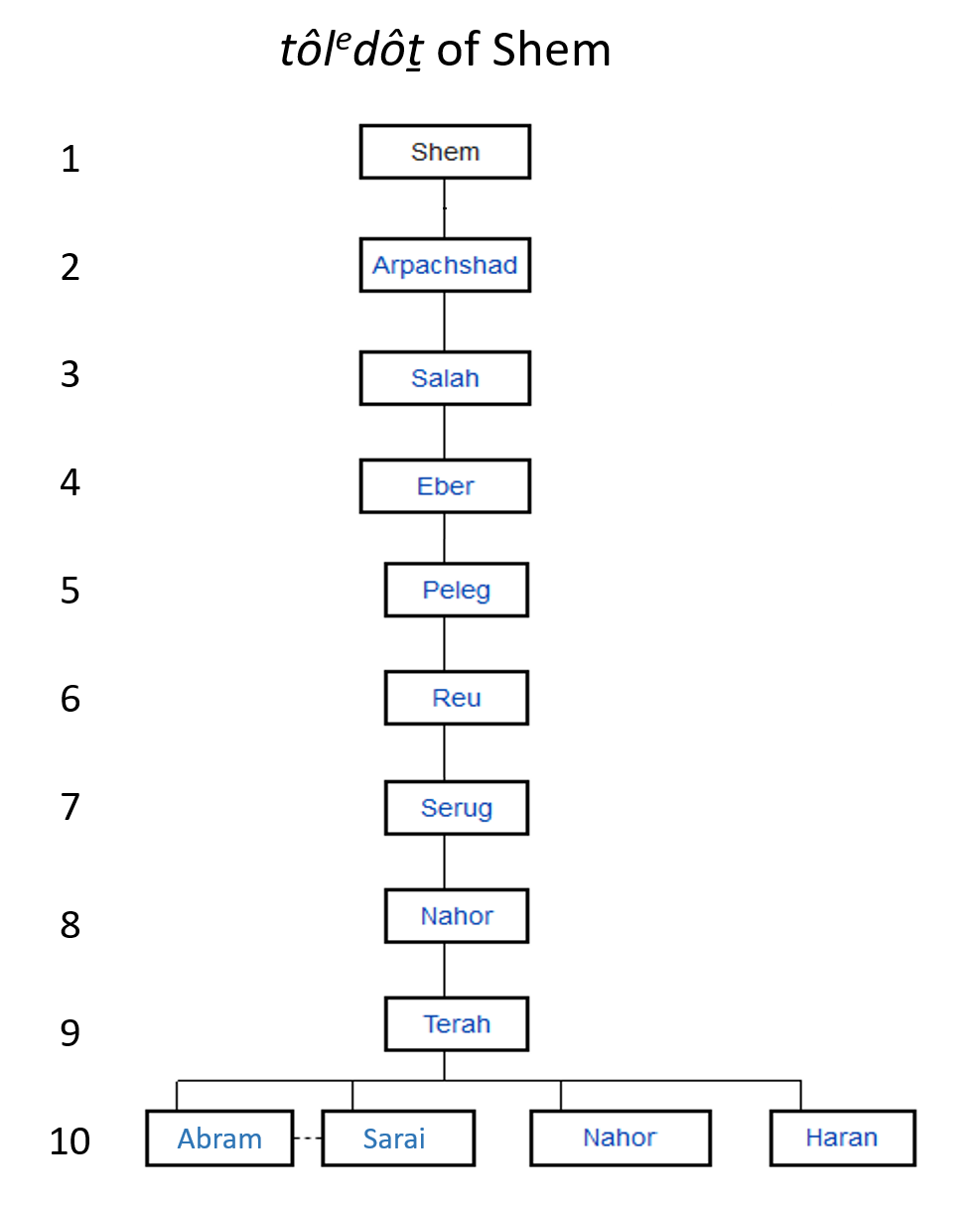 Image Caption: Toledoth of Shem. Source: Shem (Wikipedia) [https://en.wikipedia.org/wiki/Shem]
The genealogy of Genesis 11:10-26 is that line through Shem that leads to Abram. Abram is a pivotal figure who forms the transition from the primordeal accounts of Genesis 1–11 and the episodic narratives of Genesis 12–50.
Genealogy Parallelism
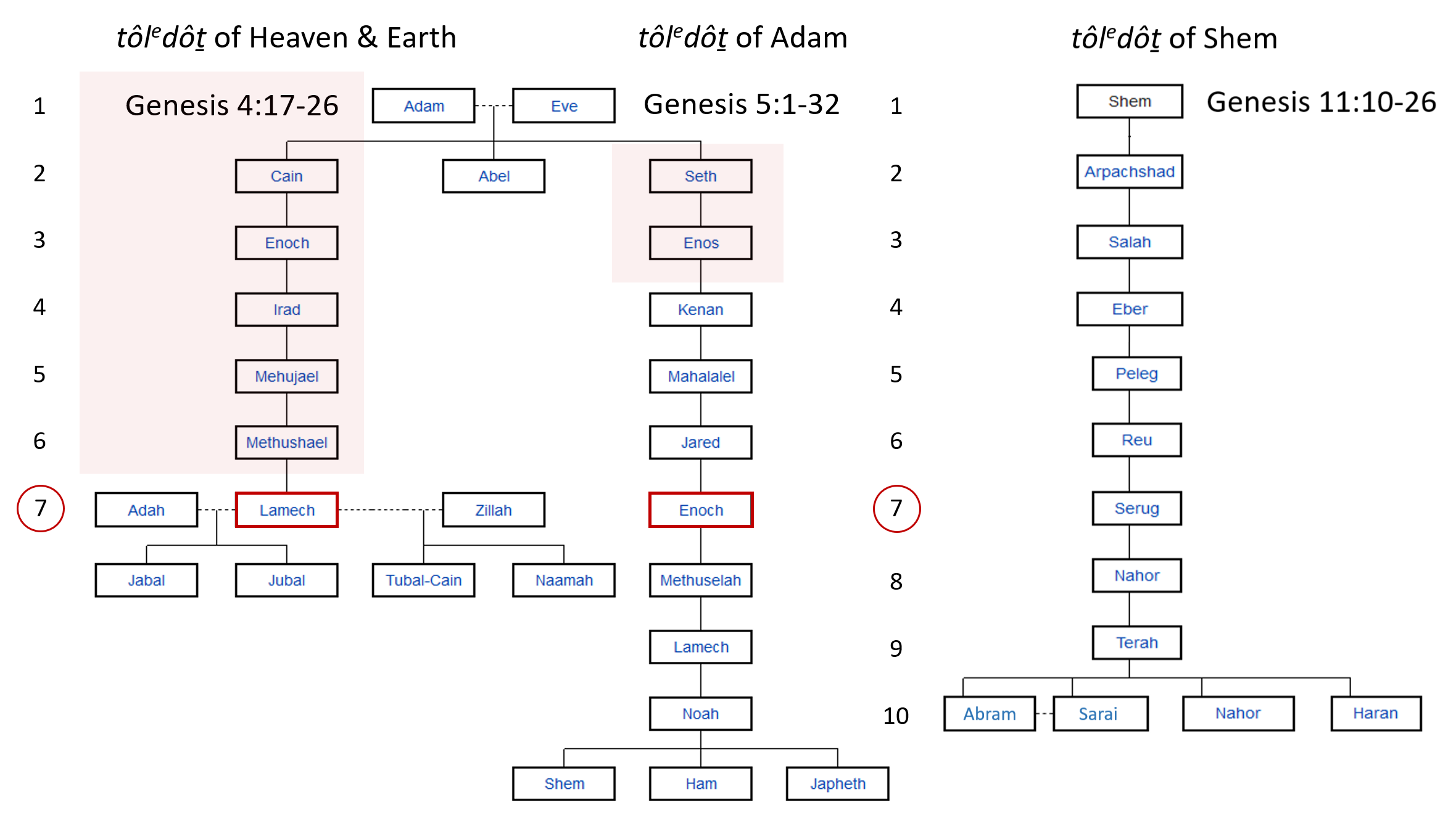 Image Caption: Toledoth Accounts of Adam through Cain, Adam through Seth, and Shem. Source: Seth, Shem (Wikipedia) [https://en.wikipedia.org/wiki/Seth] and [https://en.wikipedia.org/wiki/Shem]
The formulaic tôledôṯ introduction of the transitional, vertical genealogical account of Genesis 11:10-26 prompts comparison with previous genealogies that begin with the formula: that of Adam (Gen. 5) and that of Noah’s sons (Gen. 10). The closest parallelism with Gen. 11:10-26 is the genealogy of Adam in Gen. 5:1-32.
The Shem genealogy differs from that in chapter 5, in that its entries neither end with 'and he died' nor tally the total number of years for each patriarch, and in that the longevity of each patriarch in Genesis 11:10-26 generally successively declines, nevertheless, there remain clear indications that the genealogical lists of Genesis 5:1-32 and 11:10-26 were designed to be compared and contrasted thematically.
The only purely vertical genealogies in Genesis 1–11 are those of 5:1-32 and 11:10-27 (that of 4:17-26 being horizontal, and that of 10:1-32 being a mixture of horizontal and vertical).
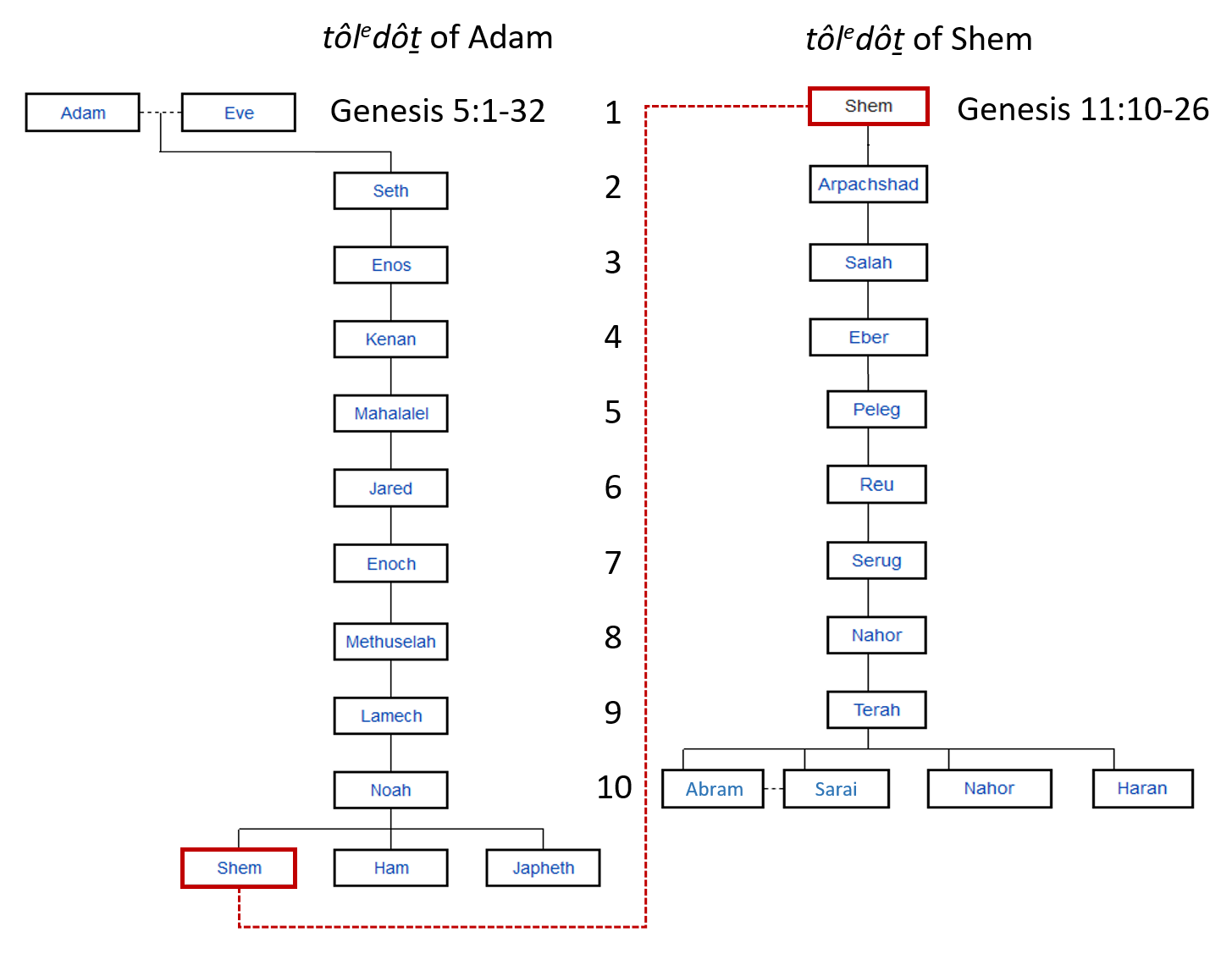 Image Caption: Toledoth Accounts of Adam through Seth, and Shem. Source: Seth, Shem (Wikipedia) [https://en.wikipedia.org/wiki/Seth] and [https://en.wikipedia.org/wiki/Shem]
The postdiluvian genealogy from Shem to Abram (11:10-26) both continues and parallels the prediluvian genealogy from Seth to Noah (5:1-32). The last of each line, Noah and Abram, is a salvific character elected by God to furnish salvation to the world. Both genealogies lead to world salvation.
These genealogies offer parallel tenfold structures, in which the last figure is both a savior and the father of an entirely new generation: Noah was the blessed father of the postdiluvian generation — a second Adam; and Abram was the blessed father of a people who were destined to restore blessing to all nations.
Although the structural parallelism isn’t perfect, both genealogies end with mention of three sons of whom the secondborn, not the firstborn, emerges as preeminent (Shem [middle son] before Japheth [oldest, 10:21] or Ham [youngest]; Abram [middle son] before Nahor [oldest, cf. 11:26, 32; 12:4] or Haran [youngest]). This inversion of the rights of primogeniture (whereby the firstborn usually prevails over others) is an ironic motif in Genesis.
Age Discrepancies in Transmission
Below are the main numerical divergences in Genesis 5 and 11 in the Masoretic Text (MT), Septuagint (LXX), and Samaritan Pentateuch (SP). Numbers in ( ) are calculations derived from other texts. Brackets [ ] are proposed reconstructions for the original text of the MT.
| Patriarch | Genesis | Masoretic Text | Septuagint | Samaritan Pentateuch | ||||||
|---|---|---|---|---|---|---|---|---|---|---|
| Siring Age | Later Years | Lifespan | Siring Age | Later Years | Lifespan | Siring Age | Later Years | Lifespan | ||
| Adam | 5:3-5 | 130 | 800 | 930 | 230 | 700 | 930 | 130 | 800 | 930 |
| Seth | 5:6-8 | 105 | 807 | 912 | 205 | 707 | 912 | 105 | 807 | 912 |
| Enosh | 5:9-11 | 90 | 815 | 905 | 190 | 715 | 905 | 90 | 815 | 905 |
| Kenan | 5:12-14 | 70 | 840 | 910 | 170 | 740 | 910 | 70 | 840 | 910 |
| Mahalalel | 5:15-17 | 65 | 830 | 895 | 165 | 730 | 895 | 65 | 830 | 895 |
| Jared | 5:18-20 | 162 | 800 | 962 | 162 | 800 | 962 | 62 | 785 | 847 |
| Enoch | 5:21-23 | 65 | 300 | 365 | 165 | 200 | 365 | 65 | 300 | 365 |
| Methuselah | 5:25-27 | 187 | 782 | 969 | 187 | 782 | 969 | 67 | 653 | 720 |
| Lamech | 5:28-31 | 182 | 595 | 777 | 188 | 565 | 753 | 53 | 600 | 653 |
| Noah | 5:32; 7:11; 8:13-14; 9:28-29; 10:21; 11:10 | 500/(502) | 350 | 950 | 500/(502) | 350 | 950 | 500/(502) | 350 | 950 |
| Shem | 5:32; 11:10-11 | 100 | 500 | 100 | 500 | 100 | 500 | 600 | ||
| Arpachshad | 11:12-13 | 35 | [430]/403 | 135 | 430/330 | 135 | 303 | 438 | ||
| Kainan | 11:13b-14a | — | — | 130 | 330 | — | — | |||
| Shelah | 11:14-15 | 30 | 403 | 130 | 403/330 | 130 | 303 | 433 | ||
| Eber | 11:16-17 | 34 | [370]/430 | 134 | 370 | 134 | 270 | 404 | ||
| Peleg | 11:18-19 | 30 | 209 | 130 | 209 | 130 | 109 | 239 | ||
| Reu | 11:20-21 | 32 | 207 | 132 | 207 | 132 | 107 | 239 | ||
| Serug | 11:22-23 | 30 | 200 | 130 | 200 | 130 | 100 | 230 | ||
| Nahor | 11:24-25 | 29 | [129]/119 | 79 | 129 | 79 | 69 | 148 | ||
| Terah | 11:26, 32; 12:1-4; Acts 7:24 | 70/(130) | (75) | 205 | 70/(130) | (75) | 205 | 70 | (75) | 145 |
Source: Henry B. Smith, Jr. 2018. "The case for the Septuagint’s chronology in Genesis 5 and 11." In Proceedings of the Eighth International Conference on Creationism, ed. J.H. Whitmore, pp. 117–132. Pittsburgh, Pennsylvania: Creation Science Fellowship. [https://biblearchaeology.org/images/Genesis-5-and-11/Smith-Henry-The-Case-for-the-Septuagints-Chronology-in-Gen-5-and-11-ICC.pdf]
The Masoretic Text yields a total timespan of about 2,008 years from the creation of Adam to the birth of Abraham. The LXX chronology yields a total of 3394 years from Creation to Abraham's birth, which is 1386 years greater than the same span in the Masoretic Text (MT).
In some LXX manuscripts, Methuselah's begetting age is recorded as 167, but scholars like Henry Smith argue 187 is the original reading to align with other witnesses and avoid placing his death after the Flood.
The LXX includes an additional patriarch, Kainan, in Genesis 11 between Arpachshad and Shelah, who is absent in the MT and SP. The inclusion is likely original, and since the patriarch is missing from both the MT and SP, the omission took place in the tradition that preceded the divergence between MT and SP.
Henry Smith avers, "The LXX’s primeval chronology, with a Creation date of ca. 5554 BC and a Flood date of ca. 3298 BC, has the strongest evidence favoring its originality."
Geopolitical Rhetoric
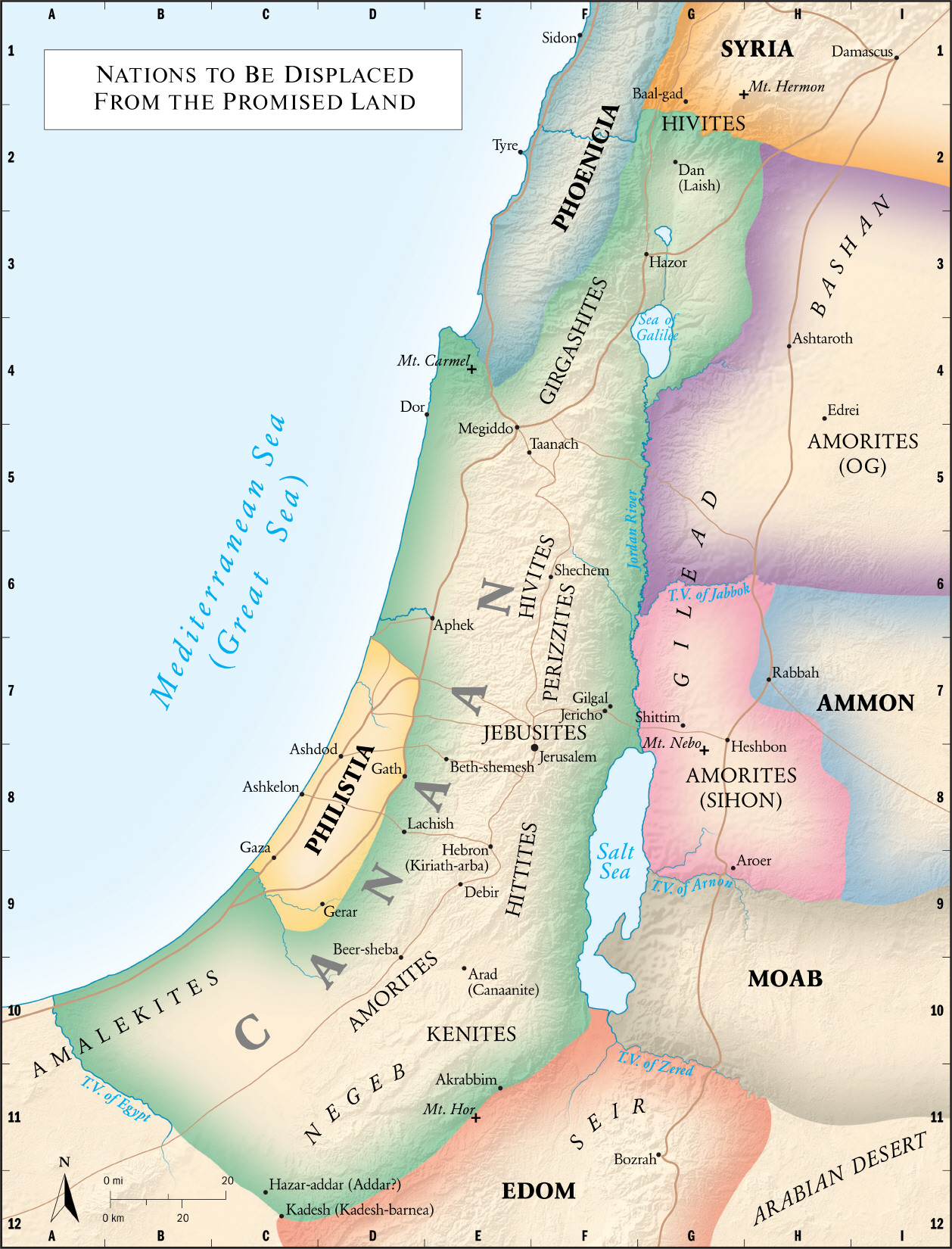 Image Caption: Nations of Canaan to Be Displaced. Source: Israel in Its Surroundings (Watchtower Online Library) [https://wol.jw.org/en/wol/d/r1/lp-e/1102003115]
To each genealogy is later appended an additional, remote descendant from the youngest of the three brothers: Canaan, who was born to Ham (cf. 9:18b, 22, 25), and Lot, who was born to Haran (cf. 11:27b; 13:1b, 5-13, 14a; 19:30-38). In both cases, this distant relative becomes the ancestor of a nation that rivals the descendants of the elect/favored son: the Canaanite descendants rival the Israelites, as do also the two sons of Lot: Moab and the sons of Ammon (cf. 19:30-38).
Perhaps the most important implication of the parallelism between the two lists is that Shem is equated with Abram, both of whom were recipients of God’s blessing (9:26-27 [mediated through Noah]; 12:2-3, etc.).
Generation 1: Shem — Genesis 11:10-11
| י אֵלֶּה תּוֹלְדֹת שֵׁם--שֵׁם בֶּן-מְאַת שָׁנָה, וַיּוֹלֶד אֶת-אַרְפַּכְשָׁד: שְׁנָתַיִם, אַחַר הַמַּבּוּל. | 10 These are the generations of Shem. Shem was a hundred years old and bore Arpachshad two years after the flood. |
| יא וַיְחִי-שֵׁם, אַחֲרֵי הוֹלִידוֹ אֶת-אַרְפַּכְשָׁד, חֲמֵשׁ מֵאוֹת, שָׁנָה; וַיּוֹלֶד בָּנִים, וּבָנוֹת. {ס} | 11 And Shem lived after he bore Arpachshad five hundred years and bore sons and daughters. {S} |
100 is a multiple of 2 and 5:
- 22 x 52 = 100 (prime factors)
500 is a multiple of 2 and 5:
- 102 x 5 = 500
- 22 x 53 = 500 (prime factors)
Their sum, 600, is a multiple of 2, 3, and 5:
- 23 x 11 x 52 = 600 (prime factors)
Generation 2: Arpachshad — Genesis 11:12-13
| יב וְאַרְפַּכְשַׁד חַי, חָמֵשׁ וּשְׁלֹשִׁים שָׁנָה; וַיּוֹלֶד, אֶת-שָׁלַח. | 12 And Arpachshad lived thirty-five years and bore Shelah. |
| יג וַיְחִי אַרְפַּכְשַׁד, אַחֲרֵי הוֹלִידוֹ אֶת-שֶׁלַח, שָׁלֹשׁ שָׁנִים, וְאַרְבַּע מֵאוֹת שָׁנָה; וַיּוֹלֶד בָּנִים, וּבָנוֹת. {ס} | 13 And Arpachshad lived after he bore Shelah four hundred and three years and bore sons and daughters. {S} |
35 is a multiple of 5 and 7:
- 5 x 7 = 35 (prime factors)
403 is a multiple of 13 and 31:
- 13 x 31 = 403 (prime factors)
Their sum, 438, is a multiple of 2, 3, and 73:
- 2 x 3 x 73 = 438 (prime factors)
Generation 3: Shelah — Genesis 11:14-15
| יד וְשֶׁלַח חַי, שְׁלֹשִׁים שָׁנָה; וַיּוֹלֶד, אֶת-עֵבֶר. | 14 And Shelah lived thirty years and bore Eber. |
| טו וַיְחִי-שֶׁלַח, אַחֲרֵי הוֹלִידוֹ אֶת-עֵבֶר, שָׁלֹשׁ שָׁנִים, וְאַרְבַּע מֵאוֹת שָׁנָה; וַיּוֹלֶד בָּנִים, וּבָנוֹת. {ס} | 15 And Shelah lived after he bore Eber four hundred and three years and bore sons and daughters. {S} |
30 is a multiple of 2, 3, and 5:
- 2 x 3 x 5 = 30 (prime factors)
403 is a multiple of 13 and 31:
- 13 x 31 = 403 (prime factors)
Their sum, 433, is a prime number.
Generation 4: Eber — Genesis 11:16-17
| טז וְאַרְפַּכְשַׁד חַי, חָמֵשׁ וּשְׁלֹשִׁים שָׁנָה; וַיּוֹלֶד, אֶת-שָׁלַח. | 16 And Eber lived thirty-four years and bore Peleg. |
| יז וַיְחִי אַרְפַּכְשַׁד, אַחֲרֵי הוֹלִידוֹ אֶת-שֶׁלַח, שָׁלֹשׁ שָׁנִים, וְאַרְבַּע מֵאוֹת שָׁנָה; וַיּוֹלֶד בָּנִים, וּבָנוֹת. {ס} | 17 And Eber lived after he bore Peleg four hundred and thirty years and bore sons and daughters. {S} |
34 is a multiple of 2 and 17:
- 2 x 17 = 34 (prime factors)
430 is a multiple of 2, 5, and 43:
- 2 x 5 x 43 = 430 (prime factors)
Their sum, 464, is a multiple of 2 and 29:
- 2 x 29 = 464 (prime factors)
Generation 5: Peleg — Genesis 11:18-19
| יח וַיְחִי-פֶלֶג, שְׁלֹשִׁים שָׁנָה; וַיּוֹלֶד, אֶת-רְעוּ. | 18 And Peleg lived thirty years and begot Reu. |
| יט וַיְחִי-פֶלֶג, אַחֲרֵי הוֹלִידוֹ אֶת-רְעוּ, תֵּשַׁע שָׁנִים, וּמָאתַיִם שָׁנָה; וַיּוֹלֶד בָּנִים, וּבָנוֹת. {ס} | 19 And Peleg lived after he begot Reu two hundred and nine years and begot sons and daughters. {S} |
30 is a multiple of 2, 3 and 5:
- 2 x 3 x 5 = 30 (prime factors)
209 is a multiple of 11 and 19:
- 11 x 19 = 209 (prime factors)
Their sum, 239, is a prime number.
Generation 6: Reu — Genesis 11:20-21
| כ וַיְחִי רְעוּ, שְׁתַּיִם וּשְׁלֹשִׁים שָׁנָה; וַיּוֹלֶד, אֶת-שְׂרוּג. | 20 And Reu lived thirty-two years and begot Serug. |
| כא וַיְחִי רְעוּ, אַחֲרֵי הוֹלִידוֹ אֶת-שְׂרוּג, שֶׁבַע שָׁנִים, וּמָאתַיִם שָׁנָה; וַיּוֹלֶד בָּנִים, וּבָנוֹת. {ס} | 21 And Reu lived after he begot Serug two hundred and seven years and begot sons and daughters. {S} |
32 is a multiple of 2:
- 25 = 32 (prime factors)
207 is a multiple of 3 and 23:
- 32 x 23 = 207 (prime factors)
Their sum, 239, is a prime number.
Generation 7: Serug — Genesis 11:22-23
| כב וַיְחִי שְׂרוּג, שְׁלֹשִׁים שָׁנָה; וַיּוֹלֶד, אֶת-נָחוֹר. | 22 And Serug lived thirty years and begot Nahor. |
| כג וַיְחִי שְׂרוּג, אַחֲרֵי הוֹלִידוֹ אֶת-נָחוֹר--מָאתַיִם שָׁנָה; וַיּוֹלֶד בָּנִים, וּבָנוֹת. {ס} | 23 And Serug lived after he begot Nahor two hundred years and begot sons and daughters. {S} |
30 is a multiple of 2, 3, and 5:
- 2 x 3 x 5 = 30 (prime factors)
200 is a multiple of 2 and 5:
- 23 x 52 = 200 (prime factors)
Their sum, 230, is a multiple of 2, 5, and 23:
- 2 x 5 x 23 = 230 (prime factors)
Generation 8: Nahor — Genesis 11:24-25
| כד וַיְחִי נָחוֹר, תֵּשַׁע וְעֶשְׂרִים שָׁנָה; וַיּוֹלֶד, אֶת-תָּרַח. | 24 And Nahor lived twenty-nine years and begot Terah. |
| כה וַיְחִי נָחוֹר, אַחֲרֵי הוֹלִידוֹ אֶת-תֶּרַח, תְּשַׁע-עֶשְׂרֵה שָׁנָה, וּמְאַת שָׁנָה; וַיּוֹלֶד בָּנִים, וּבָנוֹת. {ס} | 25 And Nahor lived after he begot Terah a hundred and nineteen years and begot sons and daughters. {S} |
29 is a prime number.
119 is a multiple of 7 and 17:
- 7 x 17 = 119 (prime factors)
Their sum, 148, is a multiple of 2 and 37:
- 22 x 37 = 148 (prime factors)
Generation 9: Terah — Genesis 11:26
| כו ַיְחִי-תֶרַח, שִׁבְעִים שָׁנָה; וַיּוֹלֶד, אֶת-אַבְרָם, אֶת-נָחוֹר, וְאֶת-הָרָן. | 26 And Terah lived seventy years and begot Abram, Nahor, and Haran. |
70 is a multiple of 2, 5, and 7:
- 2 x 5 x 7 = 70 (prime factors)
Generation of a Nation
The genealogy deriving from Shem forms an important transition to a major division in Genesis, that between the primordeal accounts of all nations (Genesis 1:1–11:26) and a series of patriarchal sagas that will give rise to a new nation (Genesis 11:27–50:26). The first patriarchal saga, that of Genesis 11:27–25:11 is that of Abram/Abraham. So, the genealogy of Genesis 11:10-26 furnishes the reader with a sense that history is now moving toward an important new human figure, one whom the original readers of Genesis already venerated as their oldest patriarchal founder.
Sources
- Biles, Deron. “Genesis 11:10–26.” Equip the Called. March 21, 2018. Accessed September 28, 2026. [https://equipthecalled.com/sermon-structure/genesis-11-10-26/]
- Dorman, Joel. “The Lineage of Blessing: Genesis 11:10–26.” Life Meets Theology, October 23, 2024. Accessed September 28, 2026. [https://lifemeetstheology.com/2024/10/23/the-lineage-of-blessing-genesis-1110-26/]
- Hess, Richard S. “Eber.” In The Anchor Yale Bible Dictionary , edited by David Noel Freedman, 2:260. New York: Doubleday, 1992.
- Ligonier Ministries. “The Generations of Shem.” Reformed Bible Studies & Devotionals. Accessed September 28, 2026. [https://learn.ligonier.org/devotionals/generations-shem]
- Serge Frolov, In Search of Abraham’s Birthplace: Between Urfa and Ur (The Torah) [https://www.thetorah.com/article/in-search-of-abrahams-birthplace-between-urfa-and-ur]